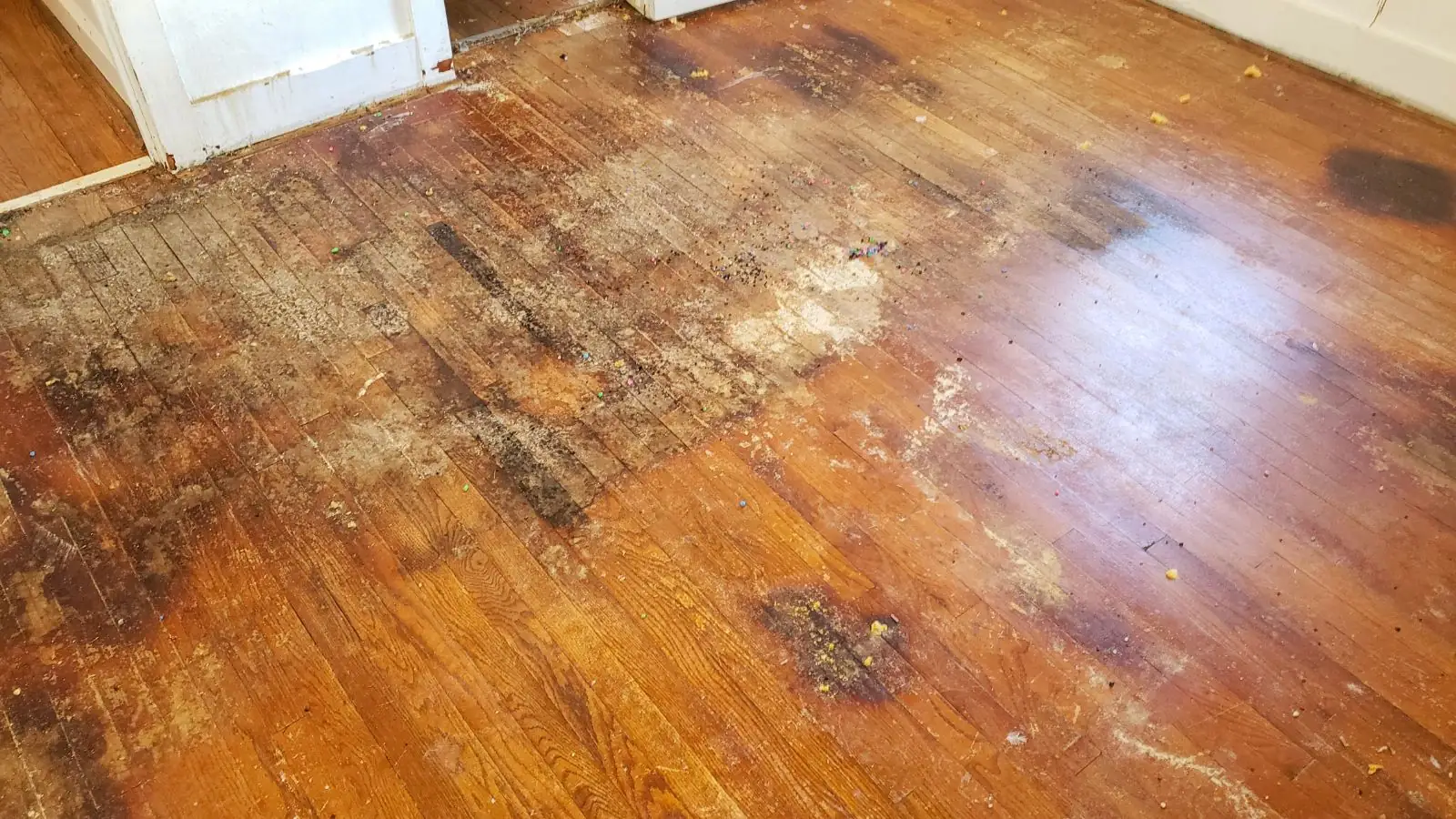
Hardwood floor water damage repair is the work of drying a wet wood floor back to a stable moisture content and then fixing whatever did not recover. In Revere, MA many houses still have their original strip oak or fir floors, and those floors can often be saved if drying starts while the boards are only cupped.
If the floor is wet now, stop the source, mop up surface water and take rugs off the boards. Do not put heaters on the floor, because fast, uneven drying cracks boards.
What the floor is telling you
| What you see | Name | What it means |
|---|---|---|
| Board edges higher than the centers | Cupping | The underside is wetter than the top. Often reversible |
| Board centers higher than the edges | Crowning | Usually a floor that was sanded while still cupped |
| Boards lifting off the subfloor | Buckling | Severe swelling. Sections usually need replacing |
| Dark gray or black stains | Water staining | Long contact with water, often with iron from nails |
| Gaps after drying | Shrinkage | Normal to a degree, may close seasonally |
Cupping is the scenario callers describe most, often after a condensate line or a washer valve leaked without anyone noticing. It is also the stage at which the floor is most likely to be saved.
Why older Revere floors are worth saving
Solid three-quarter inch hardwood can be sanded and refinished several times, and old-growth boards are denser than most new flooring. Replacing a room of it with matching material is costly and seldom matches well. Drying in place keeps the original floor.
Humidity is the complication. With Broad Sound on one side and Rumney Marsh on the other, summer air in Revere is damp, and wood moves with it. A floor that took on water in August is drying against the weather, so dehumidification has to do work that open windows cannot.
How wood floors are dried
- 1
Measure
A wood moisture meter reads the boards and, through small probe holes, the subfloor. Readings from an unaffected room set the target.
- 2
Dry from above
Floor drying mats are sealed to the boards and connected to a vacuum unit that pulls moisture up through the seams.
- 3
Dry from below
Where there is a basement or crawl space, air movers and a dehumidifier dry the subfloor from underneath.
- 4
Control the room
An LGR dehumidifier holds the air dry and steady so boards release moisture evenly.
- 5
Wait, then finish
Sanding happens only after moisture content has returned to normal and held. Sanding a cupped floor too early causes crowning.
Want a moisture reading on your floor?
Call and tell us what leaked and how long ago.
Dry, refinish or replace?
Dry only: boards cupped mildly and flattened as they dried. Dry and refinish: boards flattened but the finish is stained or rough. Replace sections: boards buckled, split or stayed black after drying, in which case new boards are woven in and the room is refinished to blend.
Laminate and many engineered click floors are a different case. Their fiberboard core swells and does not go back, so wet laminate is normally replaced. Carpeted rooms are covered on the carpet water damage page.
Find the source first
A floor that cups with no obvious spill is taking moisture from somewhere: an appliance leak under a dishwasher or refrigerator, a pipe below, or a damp space beneath the floor as described on the crawl space page. Drying without stopping the source does not last.
What not to do with a wet wood floor
- Do not sand cupped boards until moisture readings are back to normal.
- Do not aim heaters at the floor or turn the heating up high to rush it.
- Do not cover the area with plastic or rugs, which hold the moisture in.
- Do not walk on boards that have lifted off the subfloor.
Target moisture content for the boards and subfloor is set by reference readings, the method ANSI/IICRC S500 describes for wood flooring.
What affects the price
Scope and price are explained before work starts. Call (833) 521-1033.
Insurance note
Floor damage from a sudden leak is often covered along with the rest of the loss. Insurers may ask whether drying in place was attempted before replacement, and the moisture log answers that. Coverage depends on the cause and your policy, so ask your insurer.
Hardwood floor questions
Will cupped boards flatten on their own?
Sometimes, if the source is fixed and the moisture is mild. Controlled drying makes that much more likely and prevents mold beneath the boards.
How soon can the floor be sanded?
After moisture readings are back to normal and stable, which may be a few weeks after drying equipment leaves.
Is this an emergency?
The floor itself is not, but time matters. If water is still present, call the 24/7 line for water extraction first.
Do you refinish floors yourselves?
The scope includes sanding and finishing where needed, explained before work starts.
Do you serve Melrose and Malden?
Yes, and Saugus and Lynn. Older homes in Melrose often have the same solid strip flooring.
Still have a question about your own situation? Talk it through with the dispatcher at (833) 521-1033.